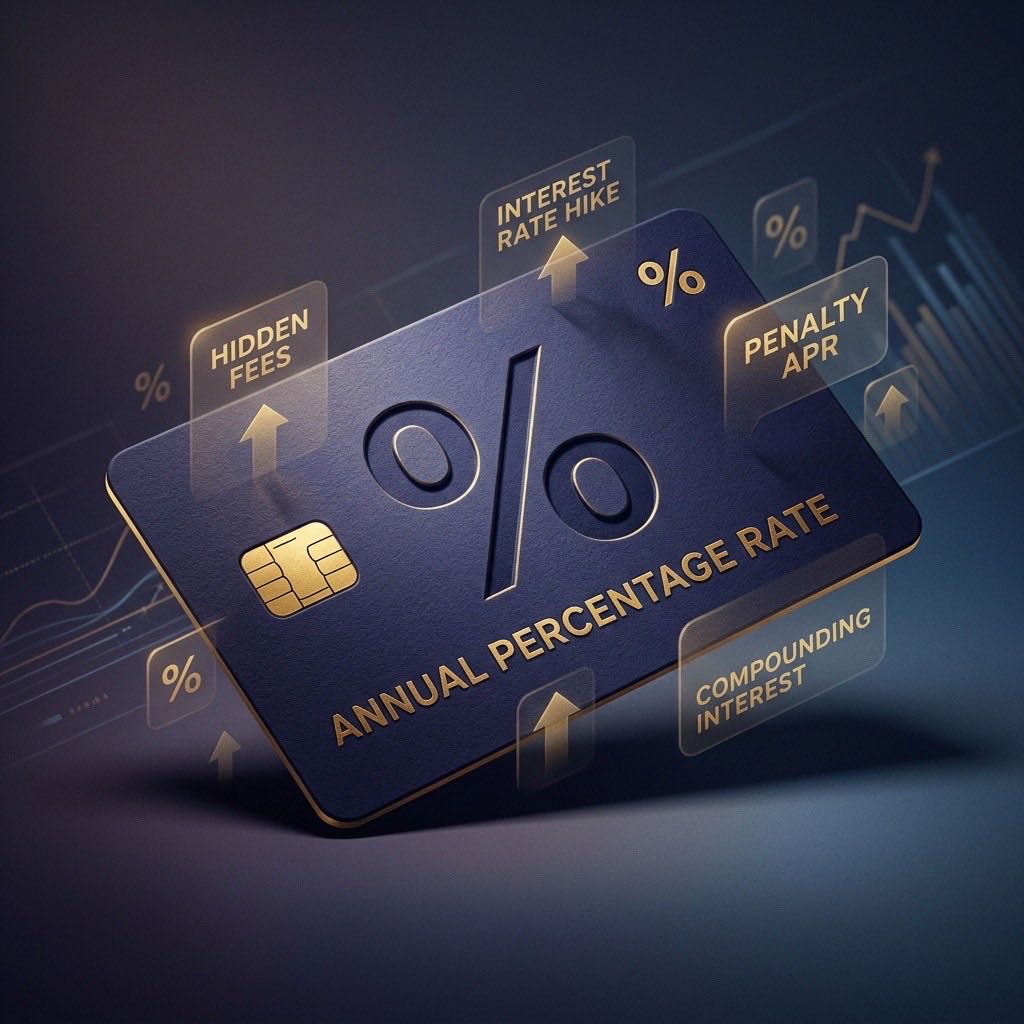
Credit Card APR Mistakes to Avoid: 7 Costly Traps to Dodge
Are you accidentally paying more than you have to? Identify the hidden credit card apr mistakes that keep you in debt longer and cost you thousands in interest.
Interest never sleeps nor sickens nor dies... it gnaws at a man's substance. — J. Reuben Clark. Understanding the traps is the first step to stopping the bleed.
The Financial Bleeding: Why APR Mistakes Are So Costly
In the world of credit card debt, interest isn't just a fee—it's a leak in your financial bucket. Every month you carry a balance at a high Annual Percentage Rate (APR), you're essentially giving away a portion of your future wealth.
Unlike a fixed-rate mortgage or an auto loan, credit card interest is dynamic and relentlessly efficient. It compounds daily, meaning the bank calculates your interest today based on what you owed yesterday plus the interest you were charged the day before. This creates a 'snowball effect' in reverse, where your debt grows faster the longer it sits.
The Real Cost of a 29% APR
On a $5,000 balance at 29% APR, you pay roughly $4.00 per day in interest. That's $120 per month. If you only make the minimum payment, you could spend over 20 years and $15,000 just to pay off that original $5,000.
Mistake #1: Ignoring the 'Penalty APR' Clause
The most dangerous mistake you can make is forgetting about the Penalty APR. Hidden in the fine print of almost every credit card agreement is a clause that allows the bank to skyrocket your interest rate—often to 29.99% or higher—if you miss just one or two payments.
Once triggered, a Penalty APR can last indefinitely, or until you make six consecutive on-time payments. During this period, your debt payoff strategy is essentially paralyzed because almost your entire payment is swallowed by the interest surge.
I didn't realize my rate jumped from 15% to 30% because of a 3-day late payment. It took me a year to even notice the change, by which point I'd paid $1,000 extra in interest. — Real User Story
Mistake #2: The 0% APR Trap (Deferred Interest)
Not all '0% interest' offers are created equal. Retail store cards (like those for electronics or furniture) often use Deferred Interest for their promotional periods. This is a massive credit card apr mistake waiting to happen.
In a deferred interest deal, if you don't pay off the balance in its entirety by the date the promotion expires, the bank will charge you interest on the entire original purchase amount, retroactive to the day you bought it. Even if you owe just $1 on the final day, you could be hit with hundreds of dollars in 'back-interest' charges.
- Crucial StrategyAlways set your autopay to clear the balance 1 month before the promo ends.
Mistake #3: Carrying a Balance on High-Interest Rewards Cards
Rewards cards (Travel points, 5% cash back, etc.) are a great tool for those who pay in full every month. However, carrying a balance on these cards is a mathematical disaster. To fund those 'free' rewards, banks charge higher-than-average APRs.
If you are earning 2% cash back but paying 27% interest, you aren't 'winning'—you're losing 25% on every dollar you carry. If you find yourself unable to pay off a rewards card in full, your first credit card apr strategy should be moving that balance to a low-interest card or a 0% transfer card immediately.
Mistake #4: Not Negotiating After a Credit Score Boost
Many people stick with the high APR they were assigned years ago when they had 'Fair' credit, even though they now have 'Excellent' credit. Banks rarely lower your rate automatically; they are happy to keep charging you the higher risk premium.
If your credit score has improved by 50 points or more since you opened the account, you have leverage. Call your bank and request a rate reduction. If they refuse, mention that you're looking at credit card apr vs alternatives from competitors. Often, the 'Retention Department' can drop your rate by 5-10% with a single phone call.
Mistake #5: Misunderstanding the Grace Period
Most credit cards have a 'grace period' where new purchases don't accrue interest—only if you paid last month's statement in full. The moment you carry over even $1 of debt, you lose the grace period for all new transactions.
This means the coffee you bought this morning starts accruing 25% interest the second you swipe the card. This 'interest leakage' makes it incredibly difficult to pay off a card while still using it for daily expenses.
Professional Tip: If you're carrying a balance on Card A, stop using it entirely. Use Card B (paid in full each month) for new purchases to keep your grace period intact on that account.
Mistake #6: Falling for the 'Minimum Payment' Illusion
Minimum payments are carefully calculated by banks to ensure you stay in debt as long as possible while still appearing 'manageable.' Usually, the minimum payment is just 1% of your balance plus interest. This covers the 'bleeding' but doesn't actually heal the wound.
Paying only the minimum is the most common credit card apr mistake because it feels like you're doing something, while in reality, your principal balance barely moves. To fight back, you must use a Debt Avalanche or Snowball method to target the principal aggressively.
Avalanche Method
Pay highest interest rates first to save maximum cash.
Snowball Method
Pay smallest balances first for psychological wins.
FAQ: Preventing APR Pitfalls
Can I get a refund on interest charges?
Occasionally. If you've been a long-time customer and had a one-time slip-up, you can call and ask for a courtesy 'interest reversal.' Banks are more likely to do this if you pay the full balance immediately.
Does closing a card stop interest accrual?
No. Closing an account stops you from making new purchases, but the existing balance will continue to accrue interest at your current rate until it is paid in full.
Is a balance transfer fee worth the mistake of staying at 25%?
Almost always. A 3% fee (one-time) is significantly cheaper than paying 25% interest (annualized) for even 2-3 months. If it takes you more than 90 days to pay off the debt, the transfer wins every time.
Stop the Interest Bleeding Today
Use our bank-accurate calculator to see exactly how much your APR is costing you and plan your escape.
Open Payoff CalculatorNote: This guide targets informational intent for credit card apr mistakes. Always consult with a financial professional for advice specific to your situation.
Scale your payoff
Add just $150 to your extra payment and see your payoff date move by 2 years.
No spam · Monthly insights · Zero noise
Ready to crush your
credit card debt?
Stop the guesswork. Use our bank-accurate calculators to find your fastest path to freedom. Zero fees. Zero catch.
- Bank-accurate math
- 100% Private & Secure
- No bank login needed
- Free forever
Takes 2 minutes · No sign up
Recommended Resources
Every month you wait costs you interest. Start your free payoff plan today.
Add your cards in 2 minutes, pick a strategy, and get a payoff plan built on the same daily-interest math your bank uses.
- No sign-up required
- No bank login
- 100% Private