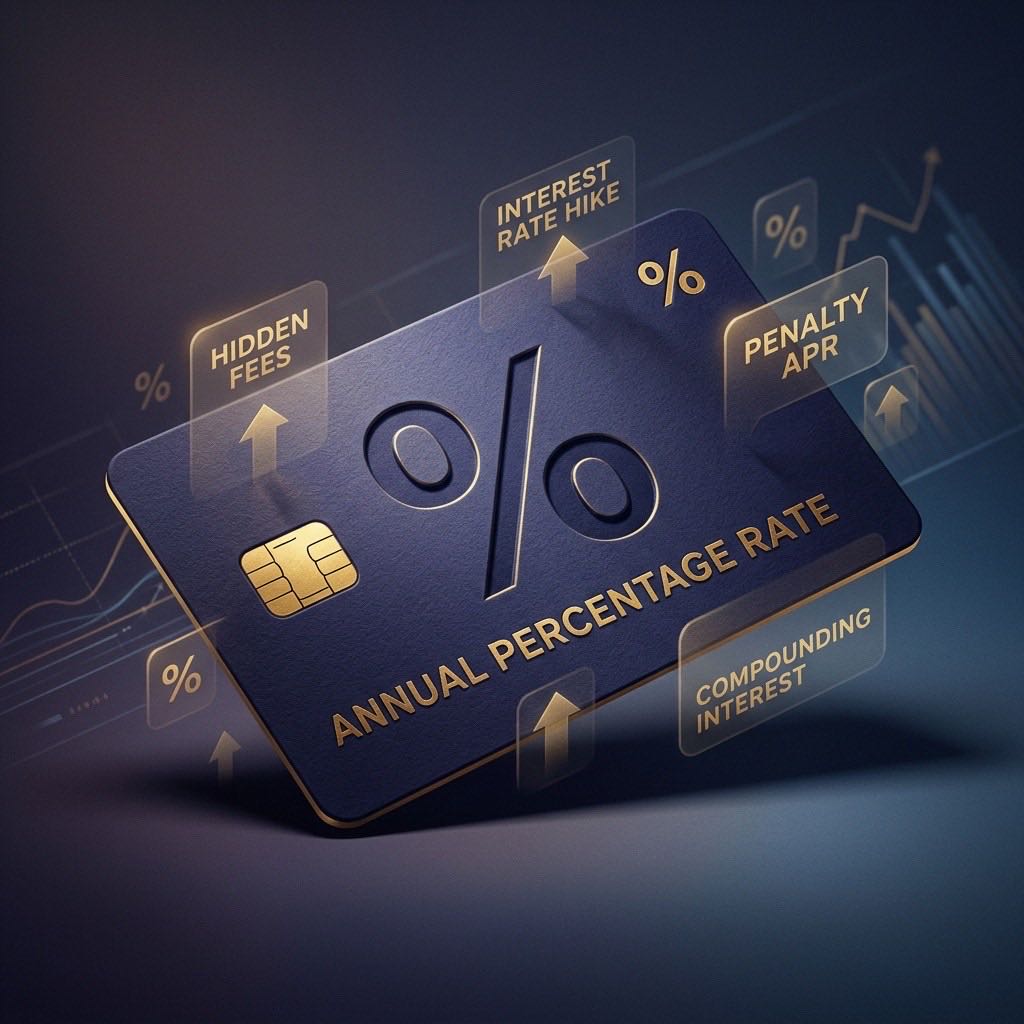
Credit Card Fees Mistakes to Avoid: 5 Silent Wealth Erasers
Don't let small leaks sink your financial ship. Identify the critical credit card fees mistakes that are quietly draining your bank account.
Interest is the price of money. Fees are the price of mismanagement. While you work on the former, you must eliminate the latter to survive the debt climb.
The Invisible Drain: How Fee Mistakes Sabotage Your Progress
Most people approach their credit card debt like a battle of interest rates. They look for the lowest APR and stay focused on the principal balance. However, there is an 'invisible drain' in the form of credit card fees mistakes that can quietly siphon away hundreds—or even thousands—of dollars over the course of a repayment plan.
Fees are often seen as 'fixed costs' or unavoidable penalties, but in reality, they are usually the result of misalignment between your card's features and your financial reality.
The Cumulative Impact
A single $40 late fee or a $95 annual fee might not feel like a disaster. But if these mistakes repeat across multiple cards or years, they can push your 'Freedom Date' back by 3-6 months purely through lost principal impact.
Mistake #1: Paying for Rewards You Don't Use
The most common annual fee mistake occurs when users keep high-tier travel or luxury cards while they are in deep debt. These cards often come with fees ranging from $95 to $695. While they offer 'points' and 'lounge access,' those perks are useless if you aren't traveling because you're focused on debt payoff.
If you are paying a $550 annual fee for a premium card but only getting $200 in actual value back, you are making a $350 mistake every year. That's money that could have wiped out a high-interest balance.
If your annual fee is greater than the cash-back value you've redeemed in the last 12 months, call your bank and downgrade to a 'no-fee' version of the same card immediately.
Mistake #2: The Cash Advance Trap
The Cash Advance Fee is arguably the most predatory charge in the banking industry. Usually, this is a flat fee (e.g., $10 or 5% of the amount) PLUS an immediate interest rate that is significantly higher than your purchase APR (often 29.99%).
Unlike standard purchases, cash advances have no grace period. Interest starts accruing the second the cash hits your hand. Using your credit card at an ATM is a credit card fees mistake that can wipe out weeks of payoff progress in a single transaction.
Mistake #3: Ignoring the 'Convenience Fee' for Statement Payments
Some utility companies, landlords, or even smaller credit card issuers charge a 'Convenience Fee' or 'Processing Fee' (usually 2-3%) for paying with a card. While this might seem like a small amount, if you are doing this to 'earn points,' you are almost certainly losing money.
If your card earns 1.5% cash back but the fee is 3%, you are losing 1.5% on every dollar. This is a classic hidden credit card fee trap where the illusion of rewards blinds you to the reality of the surcharge.
Mistake #4: Miscalculating the ROI of a Balance Transfer
A balance transfer is a powerful tool, but it's not free. Most cards charge a 3% to 5% Balance Transfer Fee. A common fee reduction trap is performing a transfer for a debt you plan to pay off in less than 3 months.
If you transfer $10,000, you are adding $500 to your debt instantly. If you were only going to pay $400 in interest over the next few months anyway, the transfer actually made you *poorer*. Always use a dedicated calculator to ensure the fee is worth the interest savings.
Check Balance Transfer ROI →Mistake #5: Forgetting to Track Automated Subscriptions
The 'Zombie Account' problem occurs when you have a card you rarely use that still has automated subscriptions (Netflix, gym, cloud storage) attached to it. Because you don't check the statement often, you might miss a small charge, which then triggers a Late Fee ($40).
This creates a cascade: a $15 subscription becomes a $55 debt, which then starts accruing interest at 25%+. Regularly auditing your automated payments is a critical part of any avoid banking fees strategy.
FAQ: Preventing Future Leaks
Can a bank refuse to waive a fee?
Yes. While many banks will waive a first-time late fee as a 'one-time courtesy,' they are not legally required to do so. Your chances of a waiver decrease significantly if your account is less than 6 months old or if you have a history of missed payments.
Does paying a fee help my credit score?
No. Paying an annual fee or a late fee does not directly help your credit score. In fact, a *late fee* is usually a precursor to a late payment report, which can devastate your score.
Is it better to close a card with a fee or downgrade it?
Always try to Downgrade (Product Change) first. Closing a card can hurt your credit score by reducing your total available credit and lowering the average age of your accounts. Most issuers allow you to switch from a 'Fee' version of a card to a 'No-Fee' version while keeping the same account history.
Stop the Financial Bleeding
Our dashboard helps you identify high-fee accounts and provides the exact tools needed to consolidate or eliminate them.
Check My Debt StrategyNote: This article identifies common credit card fees mistakes. Always consult your specific card agreement for the most accurate and up-to-date fee schedule.
Scale your payoff
Add just $150 to your extra payment and see your payoff date move by 2 years.
No spam · Monthly insights · Zero noise
Ready to crush your
credit card debt?
Stop the guesswork. Use our bank-accurate calculators to find your fastest path to freedom. Zero fees. Zero catch.
- Bank-accurate math
- 100% Private & Secure
- No bank login needed
- Free forever
Takes 2 minutes · No sign up
Recommended Resources
Every month you wait costs you interest. Start your free payoff plan today.
Add your cards in 2 minutes, pick a strategy, and get a payoff plan built on the same daily-interest math your bank uses.
- No sign-up required
- No bank login
- 100% Private